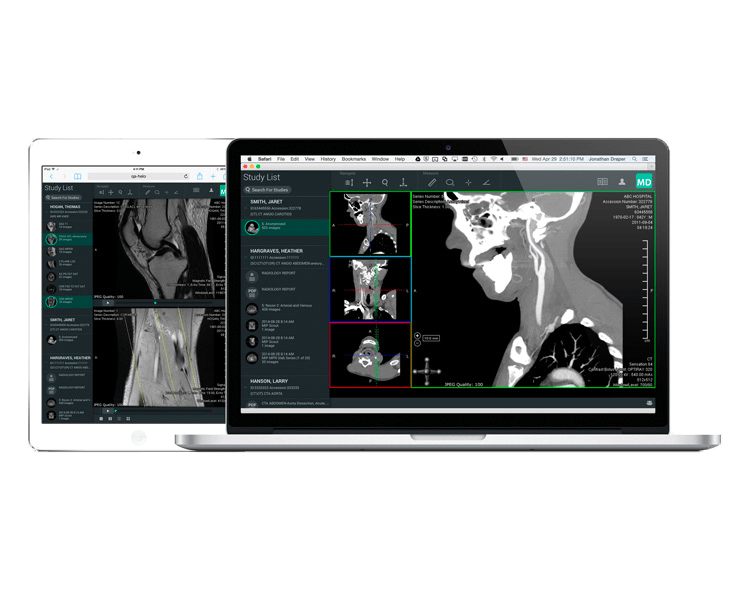
The Weekend the PACS Went Down: Running an Enterprise Viewer as the Primary Read Path
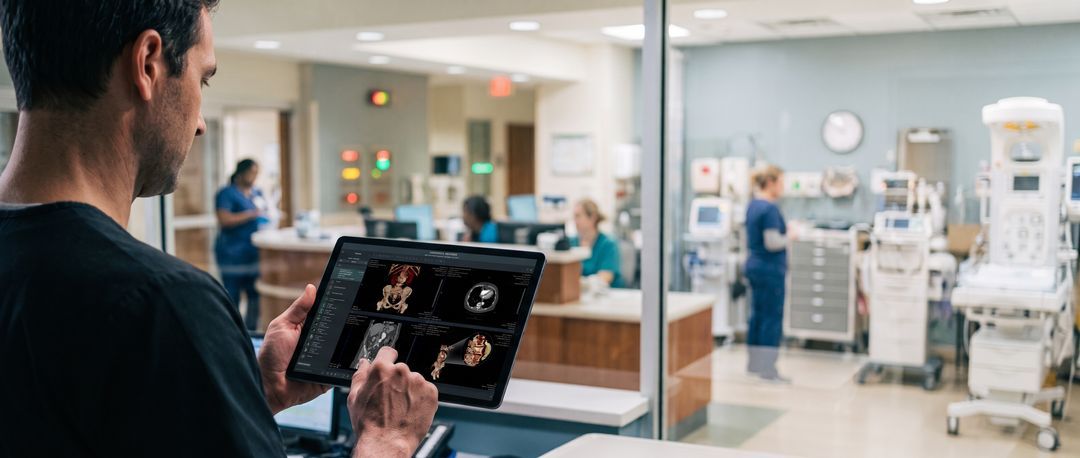
Most imaging continuity plans answer the wrong question. They answer "where is the second copy of the data?" when the question that actually gets asked at 2am on a Saturday is "what are my clinicians supposed to open?"
Those are not the same question, and conflating them is why so many well-documented DR plans collapse on contact with an actual outage.
A UK NHS trust ran ResolutionMD as its primary imaging viewer through an entire weekend of PACS downtime. That happened in production, not in a tabletop exercise. What is worth examining is not the heroics of the weekend itself but the unglamorous reason it worked: the viewer was not a sealed glass box labelled "break in emergency." It was already in daily clinical use. People had credentials. The EMR launch points already existed. On-call clinicians had opened it before, on their own devices, for ordinary reasons.
That is the whole lesson, and it argues against how most continuity planning for imaging is done.
The archive usually survives. The read path is what dies.
Look honestly at the outages your organisation has actually had. Storage loss is rare and catastrophic, which is why it absorbs most of the DR budget. Far more common are the mundane ones: a failed database upgrade, a certificate expiry, an authentication dependency, a network segment, a virtualisation host, or a vendor patch that goes sideways on a Friday afternoon.
In nearly all of those, the pixels are completely intact. The studies are sitting in the archive, uncorrupted, perfectly retrievable. What has failed is the ability to display them. Clinical work stops anyway.
So the real continuity requirement is not a second copy of the data. It is a second, independently-failing path to the data you already have. ResolutionMD is built around exactly that distinction: it connects to existing PACS and VNA repositories through federated, tiered multi-archive search, without moving or copying your data. There is no second archive to synchronise, no reconciliation problem, no duplicate storage footprint to justify. There is a second route to the first archive.
"Our PACS already includes a viewer" is true, and irrelevant on the day it matters
This is the single most common objection we hear, and the honest answer is not that bundled viewers are bad. Many are perfectly good. The answer is that a bundled viewer is fate-shared with the thing it is bundled to.
Here is a test worth running in your next continuity review. Write down every dependency your bundled viewer shares with the PACS itself:
- Same application servers, or servers in the same cluster?
- Same database instance?
- Same authentication provider and service accounts?
- Same upgrade and patch cycle?
- Same vendor support queue, with the same ticket, during the same incident?
Count the shared items. Each one is a single point of failure that takes out your production read path and your backup read path in the same stroke. A viewer that is four-for-five on that list is not a continuity control. It is the same control, drawn twice on the architecture diagram.
This is not an argument for replacing your PACS. It is an argument for not having exactly one way to look at an image.
Cold standby is a myth in clinical software
There is a comfortable fiction in IT that a dormant system can be activated on demand. For infrastructure, sometimes. For clinical applications used by hundreds of busy humans under stress, almost never.
A viewer that nobody has logged into in eleven months will fail at the human layer long before it fails at the technical layer. Accounts will have lapsed. The on-call consultant will not know the URL. Nobody will remember whether it supports MPR. The help desk, already saturated by the outage, becomes the bottleneck.
The practical conclusion is uncomfortable for how continuity gets budgeted: the only backup read path that works is one that is also a production path on an ordinary Tuesday.
Which means the business case should not be written as DR at all. It should be written as:
- On-call and remote access
- Mobile access for referrers and surgeons
- In-context launch from Epic or Cerner for occasional image reviewers
- Multidisciplinary review
Continuity is what you get for free once those people are using it every day. That is precisely the sequence that produced the downtime weekend. The deployment existed for routine access. When the PACS went down, nothing had to be activated.
What a viewer actually needs to carry the primary read path
Being available is not the same as being sufficient. If an enterprise viewer is going to take the clinical load for 48 hours, four things have to be true:
- Diagnostic clearance on the devices people will actually be holding: Over a weekend, reads will happen on a home laptop or ward tablet. ResolutionMD holds Class II/IIa/Class B clearances across 12 named regulatory authorities (including FDA 510(k) K260500, EU MDR, and Health Canada) covering web and mobile. The clearance class that applies to the workstation applies on the phone.
- Performance that does not depend on the endpoint: Images are pulled into server RAM for the session and rendered server-side. A consultant on domestic broadband gets the same 2D, MIP/MPR, and 3D volume rendering as someone on the hospital LAN at 100% original resolution—with zero patient data cached on the device.
- More than one way in: URL launch in patient/study context from Epic (Imaging tab, plus Canto launch of iOS app) and Cerner (report URL, toolbar button, MPage embed), alongside direct login. Measured customer integration effort is ~4 hours for Epic and ~5 for Cerner.
- A clear statement of what it does not do: ResolutionMD is not a reporting workstation. There are no hanging protocols and no radiology reporting depth. A downtime weekend is a triage and urgent-read posture (ED, stroke, inpatient decisions, on-call consults). Routine reporting backlog gets cleared after the PACS returns.
Making the continuity story defensible to IT
Imaging directors lose this argument internally not on clinical merit but at infrastructure and security review. Go in with the specifics pre-answered:
- Architecture: On-premise or your own cloud tenancy; no vendor hosting; data stays behind your firewall. GPU is optional; Windows and Linux are both supported.
- Authentication: Admin-controlled (OAuth2/OpenID, SAML, LDAP/AD), audit logging, role-based feature visibility, and role-based session timeouts.
- Compliance Evidence: ISO 13485, standard BAA, architecture/data-flow diagrams, HIPAA/GDPR compliance statements, and source code escrow. (Note: We do not hold SOC 2, ISO 27001, or HITRUST).
- Redefine your RTO: Your imaging RTO should not be measured as time to restore the PACS. It should be measured as time to first study displayed to a clinician by any means.
Test it on a Tuesday
Tabletop exercises validate documents. Run a real one instead.
Pick one department, one four-hour window, and route it entirely through the independent viewer with the bundled viewer off the table. Measure three things:
- Minutes to first study displayed.
- Percentage of clinicians who got in without calling the help desk.
- Workflows that genuinely could not be completed.
Resilience in enterprise imaging is not bought in a disaster recovery line item. It is a by-product of having an independently failing read path clinicians already use every week.