"Our PACS Already Includes a Viewer": Four Jobs the Bundled Viewer Was Never Built For
The objection is almost always true. If you bought a PACS in the last decade, it came with a viewer, and that viewer is probably good at what it was designed to do. We are not going to argue otherwise, and we are not asking anyone to replace a PACS.
The problem with the objection is not that it is wrong. It is that it answers a question about the contract rather than a question about the work. "Included" tells you a viewer exists. It does not tell you how many of your clinicians are actually on it, what happens to it when the archive behind it stops responding, or what it costs to extend it to the 300 referring physicians who look at two studies a month each.
Here is the framing we find more useful: A PACS-bundled viewer is scoped against the department and against the PACS. That scope is a design decision, not a defect. But it means four specific jobs sit outside it by construction, and those four jobs are where the access complaints in your inbox actually come from.
Job 1: Being available when the thing it is part of is not
A viewer that ships with the PACS shares the PACS's failure domain. When the archive, the database, or the application tier goes down, the viewer goes with it. That is not a criticism of the product; it is arithmetic.
Downtime planning in most imaging departments ends at "we have a downtime procedure." Ask what the procedure actually gives a clinician at 2am on a Saturday and the honest answer is often: prior reports, a phone call, and a wait.
An independent viewer sitting alongside the PACS, pointed at your VNA or a secondary archive, breaks the shared dependency. We have seen this run in production, not as a tabletop exercise: one UK NHS trust ran ResolutionMD as its primary imaging viewer through an entire weekend of PACS downtime. Other sites have stood it up inside an unplanned outage because it was already deployed and integrated.
The same property makes an independent viewer invaluable during a PACS migration or multi-site consolidation. Federated, tiered multi-archive search means clinicians query old and new repositories from one interface while the back end moves underneath them, without copying data anywhere.
The test: Draw your downtime plan as a dependency diagram. If every box traces back to the same PACS application tier, you do not have a continuity plan. You have a restore plan.
Job 2: Full diagnostic depth on the device the on-call clinician actually has
This is the one we would ask you to verify with your own users rather than take from us. Our field observation is that mobile functionality in bundled viewers is usually limited, but the only evidence that matters is what your on-call radiologists and stroke team say about the last time they tried to work from a phone.
The structural issue is where rendering happens:
- Client-side viewers push the volume down to the endpoint, so performance and capability track the physical device. This is why mobile builds tend to become stripped-down, reduced-feature versions of the desktop client.
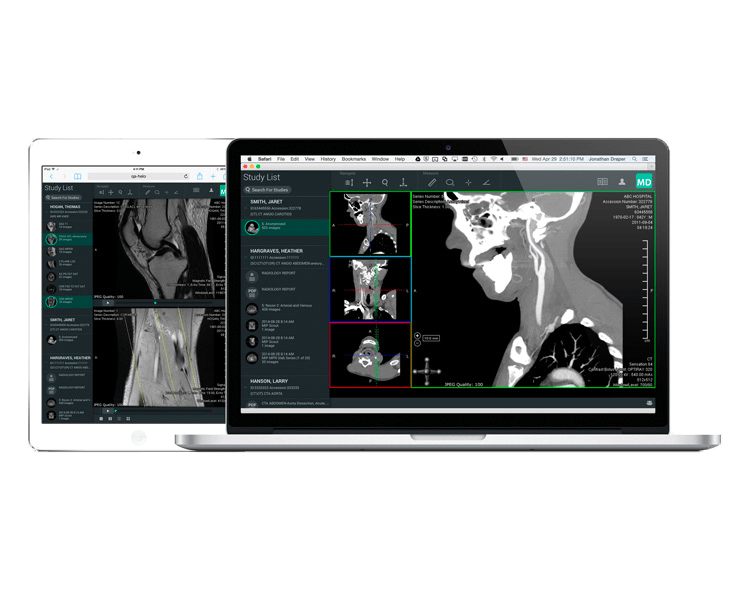
- ResolutionMD renders server-side: The study is loaded into server RAM for the session and only rendered frames travel across the network.
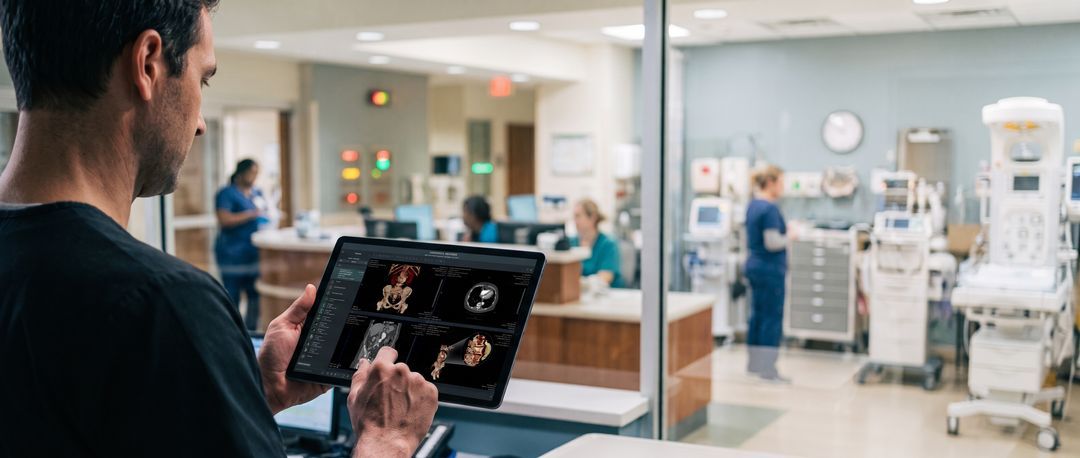
This enables full 2D, MIP, MPR, CMPR, thick-slab, and 3D volume rendering on a phone or tablet at full original resolution, with zero images cached or stored on the device.
It also unites the regulatory and security conversations. Clearances (Class II/IIa/Class B across twelve authorities, including FDA 510(k) K260500 and EU MDR, with mammography and tomosynthesis cleared from 9.2) cover web and native mobile apps alike. And because no patient data leaves the server, "remote access" does not mean "uncontrolled data on an endpoint."
Job 3: Collaboration that includes people outside the department
The bundled viewer's user model is a single logged-in user at a workstation, reading a study. That model does not stretch comfortably to:
- An MDT where a surgeon, an oncologist, and a radiologist need to look at the exact same slice simultaneously from three different locations.
- A second opinion requested from an external specialist at another institution.
- A teaching session that requires live cases rather than exported slides.
Our customers run all three on ResolutionMD daily: real-time multi-party audio and video sessions with built-in text chat, driven from the live study rather than a clunky desktop screen share. Telestroke, teleradiology, medical education, and LMS integration are all production use cases in the base. Version 9.2 adds offline, asynchronous study sharing via secure PIN-protected links when real-time schedules do not align.
Additionally, embedding live diagnostic imaging into a patient portal (such as Epic MyChart) is notoriously difficult to deliver with standard bundled enterprise viewers.
Job 4: Scaling to occasional viewers without the licence line scaling with them
Most enterprise image-access problems are not radiologist problems. They belong to the long tail: referring physicians, surgeons, ED clinicians, and specialists at acquired sites, each of whom views a handful of studies and none of whom should require a dedicated PACS seat.
That tail is exactly where bundled licensing becomes cost-prohibitive, because the viewer is priced inside a platform scoped for radiology specialists. Adding an independent ResolutionMD layer consistently costs less than expanding named viewer licences with the incumbent PACS vendor for that broad population.
Customer-side integration effort for that tail remains minimal:
- Epic: Roughly 4 hours for launch in patient and study context (longer if configuring SMART on FHIR SSO).
- Cerner: Roughly 5 hours across three production methods (report URL, toolbar button, and MPage embed).
What should stay exactly where it is
We are deliberate about this because boundaries build credibility. If your requirement is primary radiology reporting with complex hanging protocols, the bundled viewer or a dedicated diagnostic workstation should keep that work.
- We do not do hanging protocols.
- We do not support XDS.
- We have no Japan clearance and no digital pathology today.
If any of those represent your core need, we are not the right fit.
On infrastructure, deployment is self-hosted: on-premise or inside your own cloud tenancy. GPU is optional, Windows and Linux are both supported, and hardware sizing guides match your existing estate. On compliance, we hold ISO 13485, supply standard BAAs, HIPAA/GDPR compliance statements, and source code escrow. (We do not hold SOC 2 or ISO 27001).
The question worth asking instead
The question is never "do we have a viewer?" You do.
The question to ask is: Which of these four jobs is currently unowned in our environment, and who is absorbing the cost of that?
If the answer is even one job, a single-site pilot in your environment is a low-friction way to test the solution. If the answer is none, your current infrastructure is serving you well.