Collaborate with External Resources: Stop Sending the Study, Start Sharing the Session

A neurosurgeon at a health system you do not share an EMR with wants to review a posterior fossa bleed before accepting the patient transfer. A paediatric spine case requires the input of a specialist three states away. A multidisciplinary tumour board includes two external oncologists, neither of whom can see what the hospital radiologist is currently navigating.
In almost every healthcare organisation, the default response to all three scenarios is identical: get the study to them. Burn a disc, upload to an exchange portal, route across a third-party network, or attach compressed files to a referral note. The entire cross-organisational image-sharing sector is built on this reflex.
It is the wrong reflex, and examining why reveals significant operational inefficiencies.
Cross-organisational imaging is treated as a custody problem. It is usually a viewing problem.
Copy-based exchange models answer the question: "How does this external facility obtain these imaging files?"
That is the correct question when the receiving facility assumes permanent custody of the patient's care and requires historical priors archived within their own local PACS. It is the wrong question for the far more common operational scenario: an external specialist who needs to review a study for four minutes, provide an actionable clinical assessment, and move on.
Treating that brief review as a file-transfer event introduces three hidden costs:
- Latency: Transfers must be requested, authorised, pushed, and reconciled into the external archive. This process takes hours or days. Urgent clinical decisions cannot wait, leading teams to proceed without specialist input.
- Loss of Custody and Auditability: Once duplicate files land in another organisation's repository or a third-party vendor's cloud, local control ends. You can verify to a regulator where the file was transmitted, but you cannot determine who subsequently accessed it, how often, or on what hardware.
- Loss of Synchronous Dialogue: Asynchronous file delivery forces the specialist to review cases alone and call later with thoughts. Nobody is looking at the same slice at the same instant. The primary value of an MDT or consult is the collaborative discussion that occurs while inspecting the exact same frame together.
The alternative: Grant a session, not a copy
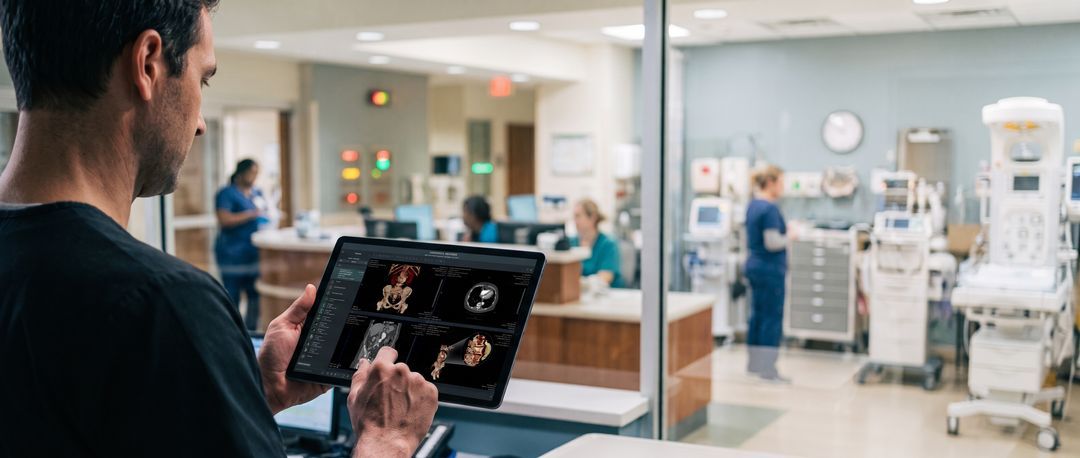
ResolutionMD relies on a server-side rendering architecture. When an external clinician connects to a study, the imaging data is loaded from your existing PACS or VNA into server RAM solely for the active session.
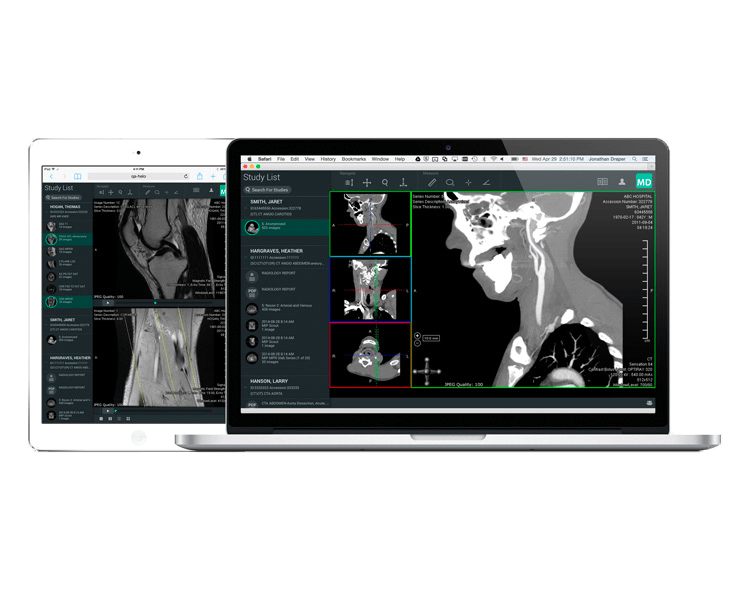
What streams to their browser or mobile device is the rendered display. No patient data is copied, downloaded, or cached on the external endpoint.
This architectural distinction changes cross-organisational interaction:
- The original imaging data never leaves your secure repository.
- The external participant receives interactive access rather than data possession.
- When the session concludes, external access immediately ceases.
This foundation delivers two critical clinical advantages:
- Uncompromised Diagnostic Toolsets: The external consultant is not restricted to flattened snapshots or pre-selected static key images. They access the exact same capabilities as the primary host: 2D, MIP/MPR, thick-slab, 3D volume reconstructions, cine playback, and diagnostic measurements—even when working on a laptop or tablet over standard commercial broadband.
- Real-Time Interactive Collaboration: The platform provides multi-party audio and video with integrated text chat directly within the viewing viewport. Both participants interact with the live study simultaneously. When one scrolls or manipulates a volume, the counterpart observes the adjustment in real time.
Because ResolutionMD maintains regulatory clearances across 12 named jurisdictions (including FDA 510(k) and EU MDR Class II/IIa/Class B status covering web and mobile clients, with mammography and tomosynthesis cleared from version 9.2), the external specialist reviews studies on a compliant platform.
External access is a governance decision before it is a technology decision
Inviting participants who exist outside your internal enterprise directory requires clear administrative controls:
- Admin-Controlled Authentication: Support for OAuth2/OpenID Connect, SAML, and LDAP/AD allows organisations to federate access through scoped directories rather than generating generic, unmonitored shared accounts.
- Role-Based Feature Visibility: External consultant profiles can be tailored specifically for review and dialogue—disabling secondary PACS capture, file exports, or administrative menus.
- Role-Based Session Timeouts: Automated termination intervals can be calibrated shorter for external access tiers to protect network integrity.
- Curated Custom Folders: Admins can isolate precisely which patient files an external reviewer can inspect, rather than granting unfettered search queries across connected archives.
- Comprehensive Audit Trails: Every external interaction generates the same granular activity logs as internal hospital reads.
Licensing structures also align with this pattern: episodic external collaborators do not require dedicated named seats. Concurrent-user licensing models ensure capacity is consumed only during active consults and instantly returned to the shared pool upon disconnect.
Asynchronous workflows when live calls aren't practical
For situations where time zones or on-call rotations make live video calls impractical, version 9.2 introduces offline study sharing via secure, PIN-protected links. The recipient accesses an ephemeral, controlled display inside your secure deployment without full directory provisioning.
Next steps for your team
If your facility routinely exchanges studies by duplicating and moving data, audit your workflows over the coming weeks: measure how many transfers result in permanent archival retention versus a single, brief clinical consult. Every instance in the latter group represents an interaction that could be fulfilled through an interactive session rather than an uncontrolled file transfer.